Pages

Showing posts with label News. Show all posts

Wednesday, 29 May 2013

iHeartRadio Signs on to Be One of Twitter’s First Lead Generation Cards Ad Partners

Last week, Twitter Advertising made headlines with the introduction of Lead Generation Cards, new functionality that gives businesses a way to register users and their emails for promotions or memberships directly within a tweet.
iHeartRadio is one of the initial partners for the new program – and we spoke to them about the motivation behind the partnership, how it benefits their users, and more.
Lead Generation Cards allow Twitter Advertising’s exclusive partners the ability to add media within the body of tweets. That capability, for a brand like iHeartRadio, which has more than 167M downloads and 16M Twitter followers across all its handles, means amped-up entertainment experiences for the brand’s following – crucial in a time when content is more ample than ever, and competition is fierce for consumers’ attention.


Monday, 27 May 2013

Twitter Lead Generation Card Simplifies Branding


Twitter last Wednesday launched its new Lead Generation Card in an effort to make it easier for users to show interest in promoted discounts from their favorite brands.
See an offer you like? Just expand the tweet, click the call-to-action button below the description, and Twitter will instantly and securely send your basic contact information—name, Twitter handle, and email address—to that business.
If The Barista Bar, for instance, is advertising its coffee club's daily deals, interested users can simply click the "Join the club!" button below the offer and their information will instantly be sent to the restaurant.
The new Twitter Card cuts out the middle man by saving signup information and removing the need to fill out another contact form each time.

"The Lead Generation Card makes it easy for users to express interest in what your brand offers," Mitali Pattnaik, Twitter's product manager for revenue, wrote in a blog post. "Users can easily and securely share their email address with a business without leaving Twitter or having to fill out a cumbersome form."


Sunday, 26 May 2013

About.Me Launches Premium Version with Custom Domains

About.me, a personal profile builder that keeps your biographical information and social media accounts on one page, has added custom domains and other features as part of a premium package.
For $4 a month, you can attach your homepage to a custom URL (yourname.com instead of about.me/name) and remove the navigation bar at the top of the page for a more customized look.
“Displaying your page on a personal domain (ie: yourname.com) has been the most requested feature from our users,” the company explained in an email to subscribers, “and we’re happy to announce it’s available.”
You’ll also have access to Google Analytics to track visitors to your page and priority support when you write in with a customer service request.


Saturday, 25 May 2013

Was Yahoo's Tumblr Buy a Smart Investment?


Yahoo's acquisition of Tumblr has dominated the tech headlines this week, so it should come as no surprise that a panel of Web publishing luminaries discussing the future of media on Thursday weighed in on the portal's recent mega purchase.
Business Insider CEO and editor-in-chief Henry Blodget called the deal "a very smart thing for Yahoo to do," adding that it's an "aggressive move" that could work out for the company. Whether the $1.1 billion price tag is worth it depends on what Yahoo does with the company, he said.
For his part, BuzzFeed CEO and co-founder Jonah Peretti believes the Tumblr deal represents a shift in media: social is no longer a niche method of consuming content, its now the dominant way people discover information.
"You'd rather get something from your friend sharing it than you would get it from a headline or have it pushed to you through the industrial media apparatus of broadcast pipes and printing presses. You'd rather have something come to you through sharing. and Marissa (Mayer, Yahoo's CEO) understood that and that's part of why she spent so much on Tumblr.
And Mark Thompson, the CEO of The New York Times Company, argued the Yahoo-Tumblr deal is also a good thing for New York City—where Tumblr is based—and the potential for tech and content to come together in the city.
But it wasn't all a Tumblr lovefest. Eventually the panel—hosted by I Want Media and titled "Future of Media: 2013—turned to Web video, a burgeoning space in online media. 'Going forward, how important is online video?' moderator Patrick Phillips asked, turning to HuffPost Live president Roy Sekoff.
"How important is LeBron James to the Heat, that would be my position on it," Sekoff said. I think it's incredibly important. It's not the only thing, but it's something that people are very interested in."
Blodget praised HuffPost's innovation in video, but predicted the site's 12-hour broadcast model won't work. "I don't think that the world wants another cable channel," he said. What is working for HuffPost, he added, is the trove of clips that come out of that half-day broadcast. Sekoff countered that the clips are actually part of HuffPost's business model.


Friday, 24 May 2013

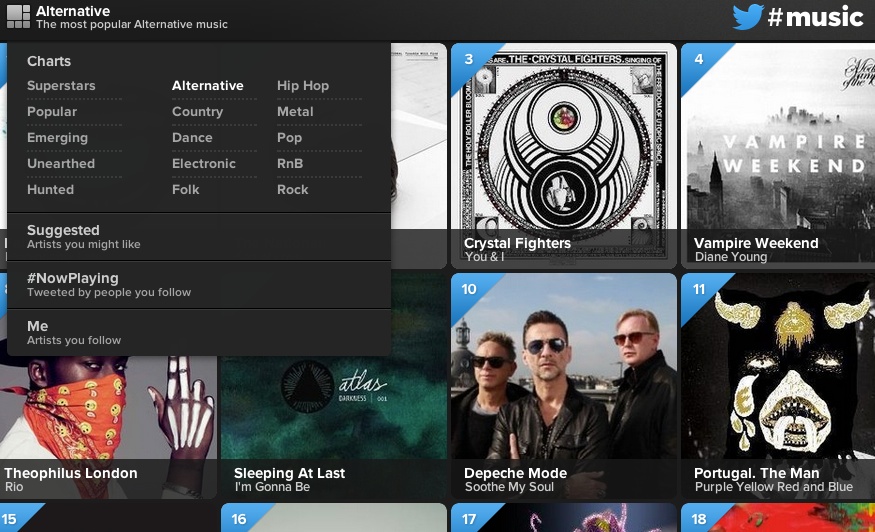
Twitter Introduces Charts By Genre And Popularity For Its #Music Service


We’ve confirmed with Twitter that it has rolled out a new part of its #Music service for the web, charts that we were accustomed to from the company We Are Hunted, that it acquired and now powers the service.
The charts are broken up into a few areas: the familiar genre breakdown, as well as some categories like “Superstars” and “Unearthed” that appear to be built based on current Twitter trends and trajectory of artist mentions. This is leveraging all of the data that Twitter is collecting from tweets that include links to tracks from popular and emerging artists.
As you click on each category, the tiles on the page swap out quickly, letting you surf around to find new artists and songs. The categorization was a necessity to be able to find hidden gems, as the original breakdown of Popular and Emerging changed so rapidly:
These are the types of charts that will get artists themselves more engaged on Twitter, as well as catch the attention of record labels who want to know what people are saying about the musicians that they’ve signed. Everyone in a band wants to know how well they stack up against others. In fact, some artists didn’t see the service coming at all, and were pleased with all of the new attention they were getting.


Wednesday, 22 May 2013

Flickr Gets A Makeover — It's Been Supersized And Instagrammed


It wasn’t that long ago that Yahoo stood accused of letting Flickr decay beyond repair. 
Today, under the guidance of new CEO Marissa Mayer, the company has given the oft maligned image-sharing community a major facelift. Yahoo’s announcement promises a Flickr that’s “more spectacular, much bigger, and one you can take anywhere.” 
Ladies and gentlemen, welcome to the grid. Here’s what’s new on your Flickr account:

Room To Grow

As recently as yesterday, free Flickr users could upload and display 200 images at a time. Now every user has one terabyte of storage space. For those of you playing along at home, that’s enough for roughly 200,000 photos. Or as the Flickr staff puts it even more dramatically, “you could take a photo every hour for forty years without filling one.”
Following Flickr’s consistently freemium model, you can get even more perks by going pro. Fifty dollars will remove all advertisements. And for the serious professional, $499.99 will double your storage space to two terabytes per year. Or, you know, more than 400,000 photos. 
If you already had an original Flickr Pro account, priced at $24.95, you’re getting a heck of a deal. Yahoo has upgraded you to the $49.99 option until August 2013, free of charge. Pro user Aaron Brazell sent us a screenshot of his pro account, pictured below:

Introducing The Grid

The most instantly noticeable change is an aesthetic one. Your photos have enlarged themselves to jaw dropping size and now dominate the screen. Taking a cue from Instagram, your home page is now an infinite scroll through your contacts’ recent photos.
Your profile page has also gone the way of Pinterest and Windows 8, filling the page with a grid of images. Just like Facebook and Twitter, your profile page includes a background photo to offset your profile picture. 
I found that Flickr had already put one of my Favorites as my background image, a photo I didn’t even take myself. As it’s not credited, I certainly hope the photographer doesn’t take issue.

Wait, What’s Going On?

A lot here has changed and Flickr power users are still trying to figure out what’s new. Flickr’s most active discussion forum, Flickr Central, is abuzz with comments about the change. Given that these are the people that continued to daily use Flickr even as the rest of the Internet complained it was dead, it’s no surprise they’re unhappy with the change.
“I signed on Flickr to post a story about Yahoo vowing not to screw up Tumblr … and then I see the clusterfuck that is the new homepage,” one user wrote
Meanwhile, confusion abounds at Flickr’s official Help Forum. I’d be amazed if the staff can answer all 1,100 plus questions that were added in the last hour. It looks like Yahoo might want to update Flickr’s FAQ guidelines, which still link to old news like the ability to pay $24.95 for a pro subscription.
If you're confused, don't add to the backlog. I have reached out to Yahoo for details on when the new FAQ will be up and will update when we know more. 

Tuesday, 21 May 2013

Yahoo Buying Tumblr for $1.1 Billion, Vows Not to Screw it up


(Reuters) - Yahoo Inc will buy blogging service Tumblr for $1.1 billion cash, giving the Internet pioneer a much-needed social media platform to reach a younger generation of users and breathe new life into its ailing brand


The deal, announced on Monday, is a bold bet by Yahoo Chief Executive Marissa Mayer to revitalize the company by co-opting a Web property with strong visitor traffic but little revenue.
The combination of Yahoo and Tumblr creates an online powerhouse with roughly one billion users, which will draw in more advertisers and help Yahoo keep visitors on its properties for longer periods of time, Mayer told Reuters in an interview.
"Tumblr in terms of users and traffic is an immediate growth story for us," she said.
Analysts say Yahoo appeared to be overpaying for a business that has never posted a profit, makes a fraction of Yahoo's sales, and may not contribute significantly to revenue for years. But the company, rebuffed by the French government when it tried to pay $1 billion for video site Dailymotion earlier this year, had to do something to plug a hole in its social media efforts.
Yahoo made clear it was sensitive to concerns that it might damage Tumblr by making it less irreverent or more corporate.
"Per the agreement and our promise not to screw it up, Tumblr will be independently operated as a separate business," Yahoo said in a statement.
The deal will make Tumblr founder and CEO David Karp, 26, a multimillionaire.
Tumblr is one of the Web's most popular hubs of so-called user-generated content, drawing young people who use the platform to post pictures and text. It has more than 100 million blogs in its network, ranging from "White Men Wearing Google Glass" - a collection of photos poking fun at the early adopters of the wearable computing devices - to housing-focused "The Worst Room."
Though Yahoo remains one of the Web's most popular destinations, it has seen its revenue shrink in recent years as consumers and advertisers favor rivals such as Google Inc and Facebook Inc. The deal is expected to increase Yahoo's audience by 50 percent.
The acquisition, which will use up about a fifth of Yahoo's $5.4 billion in cash and marketable securities, is the largest by far since Mayer took the reins in July with the goal of reversing a long decline in Yahoo's business and Web traffic.

Wednesday, 15 May 2013

Which Social Networks Are Growing Fastest Worldwide?


Twitter, Google+ see major gains in active users

The social audience is growing across networks and countries. That is the takeaway from GlobalWebIndex’s “Stream Social: Quarterly Social Platforms Update.” The study found that Facebook remained the No. 1 social network worldwide, with just over half of internet users logging on to the site at least once a month in Q1 2013. eMarketer puts worldwide Facebook penetration slightly higher, expected to reach 60% of internet users this year.
Behind Facebook, there was a crowded field of second-place contenders, with Google+ out front at 26% of internet users. In the US, Google+ gets limited attention, though its user base is growing. Worldwide, however, Google+ has been much more successful. Given that YouTube was right behind, in use by one-quarter of active internet users, there’s no question that Google, which owns YouTube, is giving Facebook a run for its money in the global social network space.
Twitter came in fourth worldwide at 22% of internet users, but GlobalWebIndex also found that the microblogging service claims the title of fastest-growing social network. Between Q2 2012 and Q1 2013, active users of Twitter rose 42% globally, according to the study.
After these major networks, local Chinese social networks garnered among the greatest percentage of users worldwide, a reflection of both the vastness of the social audience in China and the limited availability of foreign properties, like Facebook, in the country.
LinkedIn and Pinterest each came in at less than 10% of global internet users.
Growth in social network usage came especially from the mobile phone and tablet, which were increasingly used for a variety of social activities. Watching videos on Facebook saw among the biggest jumps in usage, with viewing increasing by 47% on both PC and mobile, and nearly doubling on the tablet. Messaging friends on a one-on-one basis via Facebook also grew substantially on mobile phones and tablets.
In terms of which regions saw the biggest user gains, Asia-Pacific countries were the biggest growth drivers. On Facebook, Japan saw the fastest growth, at 42% change vs. Q2 2012. In South Korea, Google+ use exploded, increasing 209%. And on Twitter, participation in Indonesia rose 44%. Saudi Arabia was not far behind, with the number of account holders increasing by 42%.

Corporate subscribers have access to all eMarketer analyst reports, articles, data and more. Join the over 750 companies already benefiting from eMarketer’s approach. Learn more.

Read more at http://www.emarketer.com/Article/Which-Social-Networks-Growing-Fastest-Worldwide/1009884#LyR41PbgO77alMQW.99 

Tuesday, 14 May 2013

Google Now Offers 15GB of Shared Storage for Drive, Gmail, and Google+ Photos, Apps Customers get 30GB


Google on Monday announced a change to how it offers free cloud storage to its users: 15GB will now be shared across Google Drive, Gmail, and Google+. This change will start rolling out over the next couple of weeks.
Previously, Google offered 10GB for Gmail plus another 5GB for Drive and Google+ Photos. Now the company has decided that it makes more sense to unify the free storage across its three services.
As part of the change, Google is tweaking its Drive storage page to show a pie chart that breaks down your storage use across the trio. Here’s how it looks:


As before, you can still upgrade your storage space. Plans range from $4.99 per month for 100GB to $799.99 per month for 16TB.
What is most interesting for Gmail users here is that the 25GB upgrade is no longer the limit. Any additional storage you purchase will also apply to Google’s email service.

Google Apps

The Google Apps story is only slightly different: Google is offering its business customers 30GB of unified storage across Drive and Gmail. Storage will also be shared with photos customers upload to Google+ larger than 2048px, and just as before, files created in Docs, Sheets and Slides don’t count against this storage quota.
Here’s the updated Google Drive storage page for enterprise customers:

Google Apps customers are also no longer limited to 25GB for their inboxes. Once again, additional purchased storage can be shared and used by Gmail.
This unification will help Google market how much storage it offers by default, as well as push its storage plans to existing users. It’s not so much a smart move, as a necessary and obvious one.


Sunday, 12 May 2013

Klout Gets Into The Q&A Business By Launching Klout Experts


So what does a high Klout score actually get you? The influence-measuring startup already offers prizes through its Klout Perks program, and there are bragging rights (unless your friends think you’re a loser for caring about your Klout score). Now Klout is asking users who are influential on a given topic to answer short, factual questions through the new Klout Experts program.
It sounds like the program won’t be rolled out to every user today, but when it is, you might Klout and be prompted to answer a question like “What is the best way to care for tulips?” or “What is the best place to take your date in the city?” You’ll have 300 characters with which to offer your answer. (Why 300? Co-founder and CEO Joe Fernandez said 140 characters isn’t always enough, but he wanted to keep the answers direct and to the point.)
Fernandez told me that Klout is working closely with Bing on this feature, so if there are relevant answers on Klout, they’ll be featured prominently when people search for a given question on Bing. Fernandez said the search engine team is also suggesting future questions that Klout could ask its users. At the same time, while Klout doesn’t have the same cozy relationship with Google, the answers should show up there, too.
For now, Fernandez said he expects most of the Klout Experts traffic to come from Bing, but you can also browse the content on the Klout site itself. The company will be highlighting recent answers from your friends. Fernandez also suggest the on-site experience will improve over time. For one thing, he said users’ various answers to a single question are currently being sorted on a single page by human editors, but Klout is working on a voting system where people can endorse the answers they like — though you can only vote if you’re influential on that topic.
klout bing
Fernandez suggested that this could eventually integrate with Perks and Klout for Business — for example, businesses could start asking their own questions and offer Perks for good answers.
When he described the new feature to me, I asked if people might think he was basically turning Klout’s user base into a content farm. Fernandez countered that these answers are going to be tied to people’s real identities, and emphasized that they won’t be able to post unless they’ve got a good score.
“What we’re good at is understanding the quality of engagement,” he said, adding that Klout scores are “a really good fitness function” for ensuring that people will create high-quality, useful content.
But why is Klout getting into this business at all? Well, Fernandez argued that Klout has become “the standard” in measuring online influence, so now it can start building other applications and uses on top of that system. Klout Experts is the first example of that.
“Influence and reputation is our platform,” he said.
Nonetheless, he also acknowledged that creating the feature has been a bit of a shift, pushing Klout to hire people who have more experience on the editorial side and with user-generated content: “How do we get people from Yelp versus Google Analytics?”
The Experts program is currently focused on technology, food, music and travel. You can view some sample answers here and here and sign up for early access here.

YouTube Launches Paid Channels, Subscription Fees Start at $0.99 Per Month


By  at ClickZ:  
The YouTube team has finally launched a pilot program for a small group of partners that will offer paid channels on YouTube – a move that had been expected since January.
YouTube has been building a partner program since 2007 that enables content creators to earn revenue for their creativity. And these content creators have built a broad spectrum of channels that have made YouTube into a news, education, and entertainment destination that 1 billion people around the world visit monthly.
According to YouTube, there are more than 1 million channels generating revenue today, and one of the most frequent requests that the creators behind them make to YouTube is for more flexibility in monetizing and distributing content.
In response, YouTube is launching a pilot program for a small group of partners that will offer paid channels on YouTube with subscription fees starting at $0.99 per month. Every channel has a 14-day free trial, and many offer discounted yearly rates.
For example, UFC fans can see classic fights, like a full version of their first event from UFC's new Select channel. And Jim Henson Family TV will be offering ad-free, exclusive content for a special introductory price of only $2.99/month, or $24.99/year.
Click on paid channels for a list of the pilot channels in the program. Users who subscribe will be able to watch paid channels on a computer, phone, tablet, and TV. And YouTube hints that subscribers will soon be able to subscribe to channels from "more devices."
"This is just the beginning. We'll be rolling paid channels out more broadly in the coming weeks as a self-service feature for qualifying partners," according to the Official YouTube Blog . "And as new channels appear, we'll be making sure you can discover them, just as we've been helping you find and subscribe to all the channels you love across YouTube.
"Just as the partner program empowered creators to take their channels to the next level, we look forward to seeing how this great community of creators moves ahead with a new way to reach the fan communities that made their channels a hit. You'll be hearing more from us, and them, as we get creator and user feedback and build out this exciting offering.
Content creators who are interested in building their own paid channel can fill out a sign up form.
While there are 53 channels in the Paid Channels pilot program, that's still an incredibly small percentage of the more than a million creators from over 30 countries around the world earning money from their YouTube videos. So, the vast majority of YouTube Partners are likely to continue monetizing their content with advertising.
That's why YouTube recently announced that the video-sharing website had hit the incredible milestone of 1 billion unique monthly visitors. The company also announced that more than 6 billion hours of video are watched on YouTube each month.
And that's why YouTube made this announcement at their Brandcast event for advertisers in New York. The amount of money to be made from advertising dwarfs the amount to be made from subscriptions. That event included a tribute to "Our YouTube Community."
Nevertheless, one-size does not fit all. So, in addition to its efforts to boost advertising from brands like T-Mobile, Samsung, Dove and Pepsi, YouTube is also offering more flexibility in monetizing and distributing content.
The cable TV industry offers a similar mix of paid and basic channels. And its worth noting that Nielsen says that YouTube reaches more U.S. adults ages 18-34 than any cable network.

Saturday, 11 May 2013

Yahoo Wants Out of Microsoft Search Deal


Yahoo and Microsoft may have just extended their revenue-per-search guarantee, but Yahoo has apparently been trying to escape its 10-year search deal with Microsoft in order to join forces with Google, according to reports.
Yahoo and Microsoft struck their search agreement in July 2009 with expectations that the partnership may allow both firms to rival Google in the search market. Under the terms of the deal Microsoft's Bing powers Yahoo search, while Yahoo uses its solid relationship with advertisers to be the salesforce for both companies.
However a Bloomberg report said Yahoo CEO Marissa Mayer has been unsuccessful in her attempts to get out of the agreement for almost a year.
According to the report, Mayer has already met with her previous employer Google and agreed to enter an alternative search partnership if the Microsoft agreement can be concluded. Yahoo was rumored to be seeking a switch to Google even before Mayer was CEO.


Friday, 10 May 2013

Will Waze Be Facebook’s Next Instagram?


By Mike Isaac at AllThingsD:  
As has been widely reported and according to sources we have confirmed it with, Facebook is indeed in serious talks to buy Waze for $1 billion, the social traffic application that helps drivers navigate the road with crowdsourced traffic information.
While no deal has been struck as yet, these sources said, the discussions are advanced and closely resemble the social networking giant’s lightning-fast purchase of Instagram a year ago.
The similarities do not stop there. The price is the same and is a mix of cash and stock, said sources. In addition, as Facebook has done with Instagram, Waze will be allowed to operate relatively independently within the company if the deal is struck.
Facebook CEO Mark Zuckerberg recently praised the purchase of Instagram, which has grown to more than 100 million active users in a short time span. More importantly, it has been a critical perceptual part of Facebook’s effort to distinguish itself in the mobile space and has added a highly engaged audience to its audience.
The news of the Waze acquisition interest by Facebook was first reported by Israel’s Calcalist. The Israeli-based company has been the subject of numerous rumors of acquisition, including by Apple and Google, neither of which seems to have panned out.
Not so here and the main question now: Why would Facebook buy a mapping company?
It’s not that much of a surprise, actually. The digital industry has moved its focus to mobile over the past few years, as users are increasingly accessing sites through their smartphones instead of desktop sites. As of Facebook’s last earnings, more than 750 million people visit Facebook via mobile device on a monthly basis.
After intense investor worry over its lack of mobile strategy caused a huge drop in its stock, Facebook quickly shifted to the idea that it needed to own the mobile experience. First, as has been reported by AllThingsD.com previously, that was going to be a proper phone. Then, abandoning that effort, the company mulled creating its own operating system. Finally, it settled on Home, essentially a Facebook-ified version of the Google Android mobile operating system that can be downloaded to run on many Android-enabled phones.


Thursday, 9 May 2013

FACT CHECK: Is Facebook Really Losing Users?

You may have heard that Facebook has lost millions of users in a short period of time and that its growth has halted. Not true.

Here are the facts. Facebook itself released numbers for Q1 2013 during its earnings report Wednesday. Daily active users, monthly active users, mobile active users -- they're all up. In fact, there's been double-digit growth in all of those categories year-over-year. Facebook now has 195 million users in the U.S. alone.

A post from The Guardian trumpeted a headline earlier this week "Facebook loses 10 million US users"; the headline has been changed to say "drop in US users." The report cited research firm Nielsen and explained:

Facebook has lost 10 million users in the US and seen no growth in monthly visitors in the UK over the past year, according to data from market research firm Nielsen.


Read the full story here >>


Sunday, 5 May 2013

Brands Can Now Be Tagged in Instagram Photos


Instagram launched Photos of You, a feature that makes it easier to see all of the photos you’ve been tagged in by friends and customers.
Previously, the only way to find out whether a photo of you was uploaded was to scroll through your activity feed. However, if your username or hashtag wasn’t mentioned, it can be almost impossible to track down every single one.
Now, using one of Facebook’s most popular features — photo tagging — app users can tag any person or brand. When someone tags you, you’ll receive a notification and the photo will be added to the new Photos of You section.
For brands, this is a particularly helpful feature as the Photos of You page can be used to show off customer-taken photos. The downside is that existing @mentions cannot be automatically converted into photo tags. Anyone wishing to add tags to old photos will have to do so manually, one at a time.
Before the Photos of You section is visible to others, you’ll have until May 16th to explore and get use to it. You can also adjust your account’s settings so that you can review photos first before they appear on your profile. You can see the feature in action in the video below, or you can upgrade to version 3.5 of Instagram on your iOS or Android device.

Thursday, 25 April 2013

Facebook Home: 5 Things You Need to Know


 By Michael Sawh at T3:
With Facebook still dominating the interwebs thanks to sheer weight of traffic, its millions of users and booming advertising revenue, Mark Zuckerberg has turned the gaze of his web-monster towards the mobile sector with the aim of making the social networking site more deeply integrated into day-to-day smartphone use by officially announcing its Android-based Facebook Home user interface which can be downloaded from Google Play. 
Aiming to turn your Android phone into a 'great social phone', Facebook is hoping to make smartphone interaction more focused on people than apps. So what does that mean? If you missed the announcement, here's five things you need to know about Facebook Home.

Cover Feed

Referring to the home screen as the soul of your smartphone, the image-centric user interface will let you swipe from left to right to see Facebook content so if you see a cool image that your Facebook friend has uploaded you can zoom in and out of it or double tap on it to Like. Facebook content can also be viewed in the lockscreen without having to make any swipes or gestures and can be turned off if you are worrying about data issues. 

App Launcher

If you are wondering where your native icons are going to go, they will be integrated into Home where your circlular profile pic icon will sit at the bottom of the screen and once tapped can open the standard applications tray as well as give you access to Facebook Messenger and a Most Recent app icon. 

Chat Heads

If you are looking at a photo or playing a game and you want to talk to a friend about it, Chat Heads will let you talk with Facebook Messenger friends and people in your contacts you'd normally just text all from one place. A small circle with your friends profile picture will pop up when a message has come through and a preview of the message to understand the context at which point you can continue the discussion all while the application you’re currently looking at is still open. If you want to close a Chat Head conversation or multiple conversations you can simply flick them off the screen. 

Facebook Home updates

Facebook announced that it will be adding new features on a monthly basis to enhance the Home experience but did not detail what kind of additions we can expect.

How do you get Facebook Home?

If you are in the US and have the most recent Facebook Android app and Facebook Messenger versions US customers will be able download it from Google Play next week with a global launch tipped in a few weeks time.
Unfortunately it will only be available for smartphones with a tablet version in the works which Facebook promises will be on the way in several months time. The other bad news is that the HTC One X, Samsung Galaxy Note 2, Samsung Galaxy S4 and HTC One will be amongst the few smartphones to be able to access Home as well as the newly announced HTC First which will have the Home software pre-loaded.